Program

Application Period is now open for the 2026-2027 academic year.
First Year
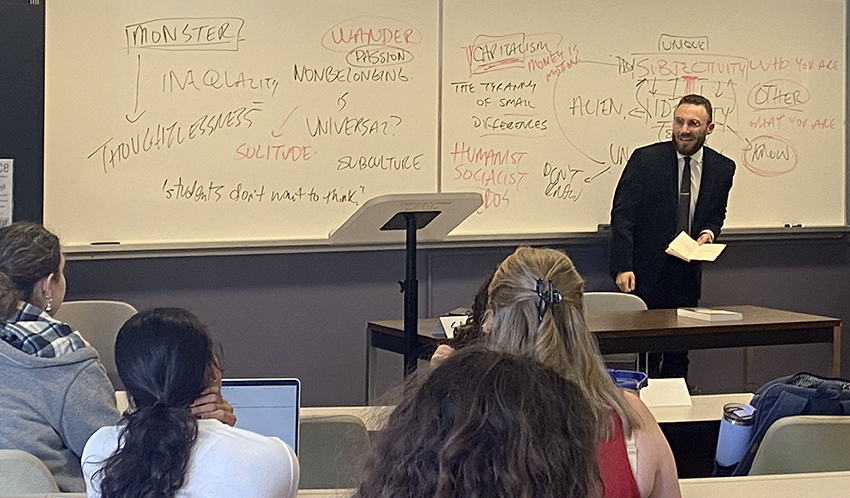
Teaching Assistant Tanner Layton leads a first-year seminar discussion on the role of the Public Intellectual
SASAH 1020E is taught by Research Fellows in the School. In lecture, discussion, and workshop formats, these faculty members will aid you in completing a variety of assignments, which might include traditional academic writing, creative work, and collaborative projects.
Our central purpose in immersing students in interdisciplinary dialogue and debate early on in the Program is to encourage you and enable you to take an active role in the future of the humanities.
The course has several objectives:
- to consider what it means to study “the Humanities” and how the Humanities needs to inform our understanding of our private and public roles. What is it to be human/inhuman, and what are our commitments as humanists?
- to reflect on the diversity of human experience, both current and historical, and the role of the intellectual in the world within the university and beyond it.
Prerequisite: Admission to the School for Advanced Studies in Arts and Humanities 3 hours/week, 1.0 course
Fall 2026
In Arabic, the word for literature and ethics is one and the same: adab. Adab suggests that it is from literature that we might generate an ethics to guide us in life. Literature can instruct us how to act, and it is not down to any one of us to instruct literature how it should act. Adab—literature as ethics—is, unlike a religious or governmental authority, not dictated by one text, one path, or one writer. Ethics, to me, is a field that is constantly being nourished, revisited, and revised with every act of reading and every act of writing. Literature has never exercised or threatened violence as governmental or religious authorities have. Considering literature as an ethics would allow us more possibilities, ethical and otherwise, than those we currently have available. These possibilities might assist us in realizing or even imagining who we are in relation to one another, and in allowing others a place within ourselves.
- Adania Shibli, “Book as Enemy”
Winter 2027
Artificial Intelligence depends on embodied beings for its own intellectual accomplishments even as its generative forms mimic human learning and creative thinking. In this course we will explore how bodies make sense of the world as embodied, as hearing, seeing, touching and affective beings. Drawing on the inspirations of artists, philosophers, and writers we will explore this theme from varying approaches. All our senses open onto the same world, the world we share with others. What does this mean for the ways we can be together? This is a question we will address but not answer.
We bring our own worlds, both individual and cultural to this sharing. We don’t all perceive or sense the same way or even have all the same senses. But this phenomenon is not a hindrance for establishing truth and shared values. Instead, if we truly attend to the world around us, we can gather a multitude of perspectives to shape meaning making, understanding and establishing facts in a complex world. Embodied being is never binary. It is never absolutely on one side or the other because there are overlappings and intertwinings. Seeing and hearing overlap and intertwine to give us the world, but they are not the same.